


Voluntourism Prezi
Katie Schneider at Vancouver Island University made this Prezi on voluntourism. It quotes a range of people on the topic and is very well done – check it out!
http://prezi.com/obnncx0uomcw/volunteer-tourism/

I called this blog ’Lessons I Learned’, but really it would be better titled ’Lessons I’m Learning’. I believe in sharing what we learn to help others avoid our same mistakes and also exposing ourselves to the criticism and questions which might help us improve. I am skeptical of the popular approaches to both voluntourism and development work, though those are both areas in which I have worked as I’d love to be part of learning how we can do them both better. I think we need to learn before we can help, so I believe “service learning” should be “learning service”. I feel like I am learning more every day about how to help create the world I want to see my future kids and their future kids living in, and sometimes what I learn contradicts what I thought I knew was true. I have learned that good intentions are not enough and that the only person you can “improve” in the world is yourself, so I had better start improving the world by starting there. I hope the dialogue generated through this site will give me more chances to do that and to share the lessons I am learning with others who could benefit from avoiding my mistakes.
Katie Schneider at Vancouver Island University made this Prezi on voluntourism. It quotes a range of people on the topic and is very well done – check it out!
http://prezi.com/obnncx0uomcw/volunteer-tourism/
I posted a new blog entry on Huffington Post called “Guilty Until Proven Innocent” – suggested an altered look at how we view non-profits. Check it out if you are interested: http://www.huffingtonpost.com/daniela-papi/non-profit-success_b_2628686.html
I just posted a new piece on Huffington Post Impact about the orphanage tourism issue in Cambodia. Check it out below:
Why You Should Say No to Orphanage Tourism (And Tell All Tour Companies to Do the Same)
The piece relates to a new website released by Siem Reap residents who are upset at the increase of orphanage tourism, orphanage corruption, and the proliferation of the institutionalization of kids in orphanages (when child rights documents globally & in Cambodia state a focus should be on family-based care as a first resort). The new website is called orphanages.no – please read it, share it, tweet it, etc. This piece comes after Unicef’s report this year that 76% of Cambodian children living in “orphanages” have one or more living parents.
Help stop well-meaning tourists from fueling the separation of children and their families!
I recently wrote a follow-up piece to my last blog about Off.Grid:Electric on the Huffington Post. If you want to read about the lessons I learned, and how the CEO plans to grow a billion dollar company with the hopes of a Nobel Prize, check out the post here: http://www.huffingtonpost.com/daniela-papi/5-tips-for-how-to-solve-t_b_1940980.html
Over course of the last year, I’d met with dozens of start-up founders and examined a range of business models looking for something that struck me as “paradigm-shifting” or “game-changing” or whatever other exaggerated and over-used term you’d like to put forth. None struck me as much as a team I met that was committed to designing a solution to one of the world’s most pressing problems while growing to be a billion dollar company. That was something I was intrigued to learn more about!
From having lived in Cambodia for six years I understood a bit about the reality of the problem they were trying to solve in off-grid communities: lack of access to electricity often led people to use kerosene for light, which was bad for the eyes, for the lungs, and for the safety of those living in highly flammable homes. Wealthier people could afford generators, which was often the most polluting, wasteful, and expensive way to produce electricity. Grid power was not arriving fast enough or was to expensive to connect to when it arrived and solar was a liability few wanted to take on after seeing systems break or get stolen in their community. The choices in an off-grid community seem quite bleak.
Enter Off.Grid:Electric, determined to figure out a business model that makes the constantly improving offerings of solar power accessible to those who need it most, thereby preventing further environmental harm, providing brighter and cleaner light, and ideally saving people money while making some of their own. Seems like quite a tall task! Match that with a CEO who has already formed two mult-million dollar companies and a founding team’s determination to create a business that can “Light Africa”, and I was sold. Sign me up please!
I spent six weeks in Arusha, Tanzania, with the Off.Grid:Electric founding team, conducting a user insights consulting project: interviewing and sitting in the homes of more than 35 of their current customers and drawing out ideas for product, service, marketing, and operations improvements based on member feedback and observations. What I learned was incredibly interesting for me, and hopefully valuable for the Off.Grid:Electric team and their customers.
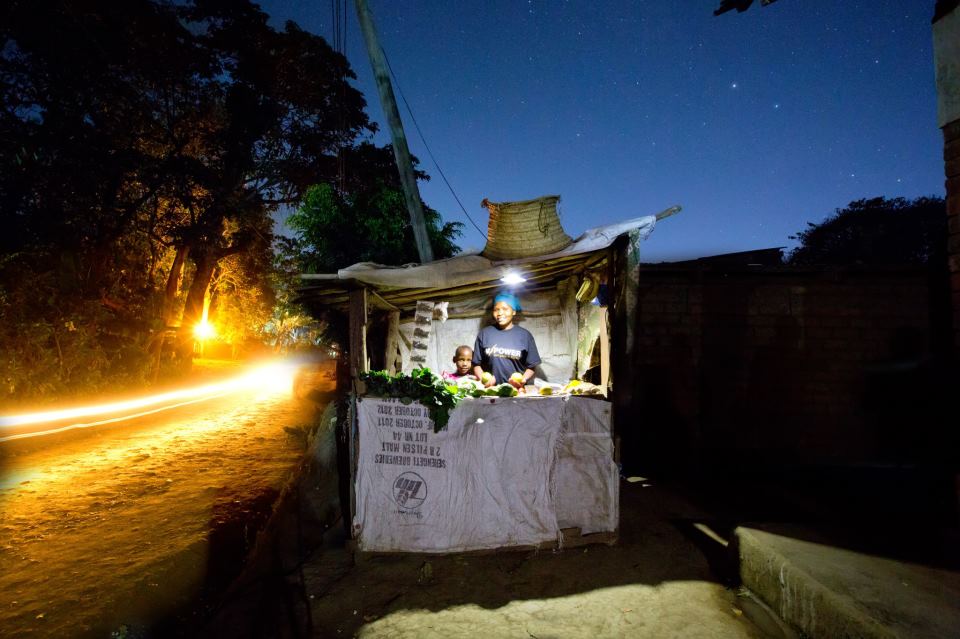
An Off.Grid:Electric member. Photo by estherhavens.com
If you have jumped ahead and already checked their website, you might be confused. It’s a little behind the times in terms of what Off.Grid:Electric is up to these days, and that’s ok: most of their customers have never been on the internet. The team didn’t even have a twitter account before I arrived and that’s ok too: less that 5% of their current customers own a smart phone, and only a few have ever heard of a Facebook status, let alone a tweet.
The Off.Grid:Electric team won a business plan competition in Oxford last year for their original idea: producing and selling solar power off of remote cell phone towers that were currently being powered by inefficient generators. The idea was a solid one, and with many supporters, they headed to Tanzania to try out their idea. Fortunately, they didn’t get married to their original model, and were open to the realization that their might be other, more efficient and scalable ways to “light Africa”.
Coming soon: a piece on the Lessons I Learned from working with Off.Grid:Electric
This is a guest post from Anna McKeon, of PEPY in Cambodia. Anna not only led PEPY’s communication team to a new logo and a new website, but also took the time to write this piece on why she thinks “easy” is not what we always need to strive for. Check it out! Thanks Anna!
—
We have a fascination with easy. Technology and service are encouraged to collaborate as closely as possible to provide a smooth, stress-free path through life. We praise experiences that are “intuitive” – where people don’t even really need to think too much to accomplish what it is they’re trying to achieve – whether it’s the weekly online supermarket shopping or travelling abroad.
More often than not there is very little value placed on the advantage of things being difficult. Difficulty tends to represent a lack of clarity, poor communication, or unsatisfactory experience. The very semantics of making something “difficult” for someone have negative, almost malicious connotations.
Recently, however, I have been wondering whether there are some things in life that should just stay difficult. Maybe some things we should have to work hard at to understand. Maybe the path to achieving our aim should not always be easy.
I was having this conversation with a colleague the other day. We were discussing the merits of the type of websites on which charities can advertize their work and state the donations and volunteers they need. I’m not a fan of these kinds of websites for a few reasons – and I won’t go into them all here – but the main thing that struck me was the conversation we ended up having about the benefits of “easy”. These websites aim to make things easier for the donor and the volunteer. To make it easier for people who want to help, to be able to do so.
That sounds perfectly logical, doesn’t it? If people want to help, that’s great – right? We should make it easy for them – in fact, as easy as possible. We should provide them with lots of different tools and services so they can find the charities they like and very easily donate, volunteer, visit. After all – if more people in the world helped then the world would be a better place. So let’s make it as easy as possible. So easy it’s intuitive. So easy that people don’t even really have to think…
And there’s the rub. It is already so easy to donate to charity. You can send a text message, or click a button online and donate. It can be a knee jerk response to a TV ad or a celebrity doing some exercise. It doesn’t require that much brain power. I know, I’ve done it. It’s also dangerously easy to volunteer. I know, because I’ve done that too – and learned a few key life lessons along the way that I really should have taken the time to learn beforehand. There are many organizations who will take under-qualified people, who they would never hire otherwise, on a short-term basis just because they are willing to work for free.
Why on earth is it a good idea to try and make this easier?
Few people, when they donate to a charity, ask questions about how the money is being used, let alone thoroughly research the methodology and impact of the organization. Maybe this lack of attention sometimes means that more money is donated, but in my opinion, this is still not a good thing. Not only can it end up supporting ineffective development practice, it also encourages “armchair karma”: texting “donate” to 81155 to buy a mosquito net for someone in Africa to gratify your need that you are “socially conscious” and “giving back”. This isn’t giving back. This is just consuming dressed up slightly differently. You’re buying good feelings to support your good intentions. You’re not necessarily buying impact or any benefits for the people you think you might be helping. Maybe you’re lucky and you hit on an organization which actually is reputable, thoughtful, and delivers nets along with training and other malaria prevention methods. Equally, your text could donate to an organization that dumps 100 nets in a village and leaves. The nets sit there and are never used, or get used for something else altogether, because the local people never asked for them, had other priorities, or were skeptical of products left as charity.
Maybe we should not be making it easier for people. Maybe we should be making it harder.
Being a donor to an organization is like any other relationship. It’s best if you try and understand the person first. Learn about them. Recognize their successes and understand their failings. Then figure out where you might fit in, how your involvement together can create something mutually beneficial. Of course there’s nothing WRONG with wanting to feel good about helping. It’s normal. But why would you want to just buy the feeling good part, without knowing whether you’re actually making a difference? If you’re in a relationship, you know. You know and you care.
It’s the same with volunteering. A day at an orphanage painting a wall is a bit like those short-term connections that lack depth or understanding. You might get an instant sense of gratification out of it but you don’t know if the other person benefited equally from the experience since you’re not going to see them again anyway. We shouldn’t pretend this is “helping” anyone, or changing the world. (Check out this video from Aljazeera about the dangers of voluntourism).
Effective volunteering means learning, understanding, communicating, and perhaps, most importantly, committing. Give a time commitment that makes sense to the organization and doesn’t prove a drain on their resources. Make sure that it’s not all about getting your “experience” but also about the organization receiving some benefit other than training someone up just to watch them leave again in 2 months time. If you can’t commit the time, or don’t have the money, then don’t do it. You can still use that goodwill, and your wish to change the world, and take action. Find an organization closer to home that you can support in a different way. Volunteer at your local school. Bake a cake for your neighbor. Or even spend the time researching issues that you care about, understanding them, and learning about how you could use your skills to REALLY help.
Helping shouldn’t be easy because it’s not. It’s difficult to help people – even if they want to be helped and even if they need it. Whether you’re talking about a friend in difficulty or a whole country, there are many things to learn and challenges to face. We’ve all been there when sometimes you just can’t help someone any more because it’s too hard. It’s too much of a drain on your time and energy. Well, that can apply to international helping too. It can be tough and confusing and it can make you wish you never tried to help in the first place.
We shouldn’t make it easy. We’re doing a disservice to ourselves. We’re encouraging each other not to think, not to explore, not to discover. We’re not challenging ourselves, our commitment, our perceptions, or our opinions. We’re promoting a life of ease where a sense of goodwill can be bought and not earned.
So let’s leave some things to be difficult. Difficulty helps us learn. It helps us discover more about the very thing we are trying to achieve. It can also mean that it feels even sweeter when we do succeed in our aims. And you know what? Even though “difficult” might be a harder sell, I still know enough people out there who are up for the challenge.
—
This is a guest post from Anna McKeon, Director of Communications at PEPY.
A few weeks ago I got a note from a soon-to-be college graduate who was looking for advice about entering the international development sector. Thank you to the people who wrote back to “Bill” with advice, as I hope that advice will be useful to many people seeking out this work. If you haven’t read his original email or the responses to it, you can do so here.
As I said I would, I am posting the response I sent to “Bill” a few weeks ago when he wrote to me (and before I posted these blogs). If you have further thoughts of advice, please share them!
—
Hi Bill –
Thank you VERY much for your email. It makes be happy to know that the things I have written have been useful to you. I understand your feelings – I am sort of in the same position! I am just about to finish my 1 year program at Oxford and now I need to figure out – what is next? How can I use my talents and interests to best impact the world in the areas I believe in? It’s very tricky to figure this out! I think part of the answer is that there is no one answer. There is no right path. It sounds like you ARE on one of the best paths, as you are already thinking about this very hard and LEARNING. That’s key! So seek out positions where you can learn. That might be with a development organization (like PEPY), an organization working in the US (like The AdVenture Project http://www.theadventureproject.org/ that supports organizations around the world), a group that rates/reviews NGOs (like GiveWell http://givewell.org/ in NY), etc. If there is a place you really want to work, you might want to reach out to them and volunteer your time for a few months. That might mean writing notes to donors or working on a newsletter – but you’d still get to learn about the issues the organization was facing.
Something like a Fulbright would be fun/interesting – but it wont be likely to give you the mentorship you are looking for. I have seen many people go through Fulbright or the Peace Corps and not take the role very seriously or be put in a location/position that was difficult and then fail to learn or contribute very much. So perhaps something where you are working underneath people you respect is more what you are looking for.
Other learning experiences – that I have not seen first hand, but have heard of include http://globalcitizenyear.org/ & http://thinkimpact.org/ – and both of those experiences allow you to learn development theory in real life settings. Of course, an alternative is to go back to school to study these things, but I tend to think that people get a lot more out of school if they have real life experience to base it on (I know that’s how I work).
I am working with a solar company in Tanzania at the moment – and though I have not worked with them myself – I have worked with many people here who used to do work with SIC http://sichange.org/ – and it sounds like they have a really great model for educating both the young foreigners who work with them in the summer and the young Tanzanians they work with all year. They might be worth looking into.
I also really liked Illich’s speech and I often read parts of it during presentations to students. I made this mock conversation with Illich once: http://lessonsilearned.org/
Development blogs: (there are tons, but here are some I sometimes read!)
http://www.how-matters.org/
http://aviewfromthecave.com
http://goodintents.org/
http://aidsource.ning.com/ (social network – haven’t seen it before – but see that some of these people are connected to it)
http://aidwatchers.com/ – Easterly’s blog which is not in use anymore but still has great content
http://www.whydev.org/
http://texasinafrica.blogspot.
http://aidspeak.wordpress.com/
Articles / Resources / Other things:
The first 25 pages of Easterly’s White Man’s Burden (required!)
http://www.pepytours.com/
http://reader.pepytours.com/ – a posterous reader which collects the articles we put up – so like a “What the PEPY Tours team is reading” RSS feed
http://lessonsilearned.org/
As far as the educational hotel chain – it is still something I’d really love to see exist, but I am not sure if I want to manage hotels! I go back and forth on this  Some friends and I are meeting up in September though to talk about how we could work with people like you – young people who want to get into development work or social impact jobs, but are looking to learn. Would it be ok if we looped you into a conference call at some point to get your feedback once we have some ideas brewing?
Also, how would you feel if I posted your email below onto my blog (with just your first name – and I can remove your school if you like so people don’t know who you are). Then I can ask other friends/people I know in this space to answer what they would give you for advice. You might get lots of interesting (and contradicting!) ideas – but it would certainly give you a lot to read and think about!
Let me know!
Once again, thanks for your note, Bill. I appreciated it!
– Daniela